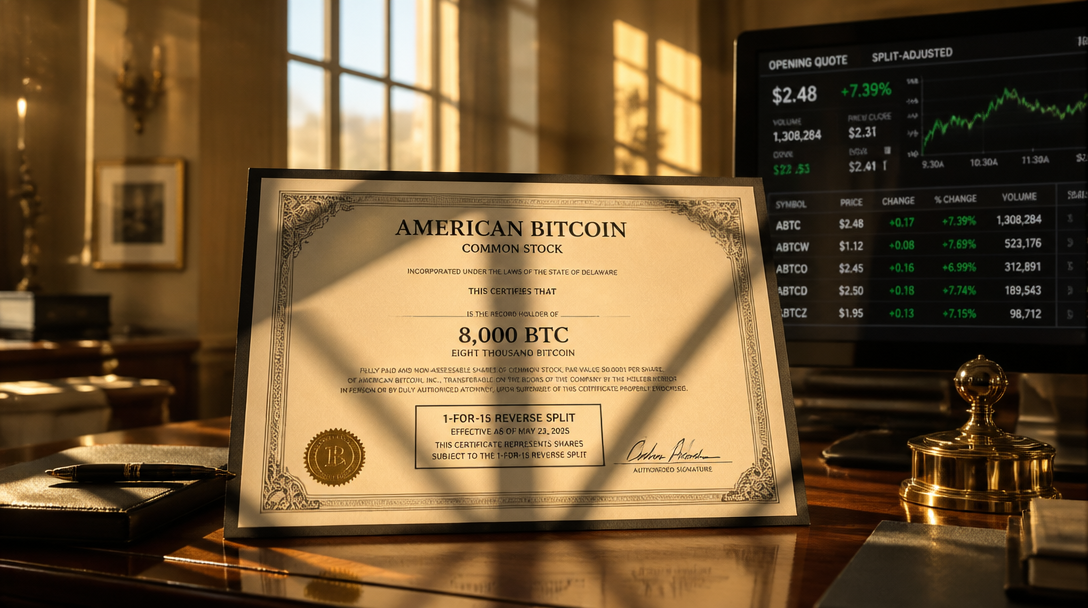
American Bitcoin approved a 1-for-15 reverse stock split effective July 2 to comply with Nasdaq’s minimum bid price requirement and prevent delisting, the company announced as its Bitcoin holdings reached 8,000 BTC.
Split-adjusted trading began on Nasdaq on July 6. The reverse split reduces outstanding share count without altering the company’s underlying asset base or authorized share pool, leaving room for future equity issuance.
Eric Trump, co-founder and chief strategy officer, said at the time that American Bitcoin held more than 7,300 BTC and ranked among the largest publicly traded Bitcoin companies. The company’s holdings have grown from 5,401 BTC at the end of 2025 to 7,021 BTC as of March 31, 2026, and now to 8,000 BTC.
Mining and Acquisition Strategy
American Bitcoin differentiates itself from Bitcoin treasury companies that rely primarily on capital raises by using mining to acquire Bitcoin below-market prices. During the first quarter of 2026, the company mined 817 BTC and purchased an additional 803 BTC.
Mining gross margin remained above 50% despite a 22 percent quarter-over-quarter decline in Bitcoin’s price during Q1 2026. The company reported $62.1 million in Q1 mining revenue, though it posted an $81.8 million net loss and a $117.2 million loss on digital assets for the quarter.
American Bitcoin’s cost to mine per BTC stood at $36,200 during Q1 2026. Bitcoin was trading at $64,000 as of July 12, down roughly 50 percent from its October 2025 all-time high.
Reverse Split Mechanics and Risks
Shareholders approved a reverse split range of 1-for-5 to 1-for-40, with the board selecting a 1-for-15 ratio. American Bitcoin’s proxy statement warned that share price might not rise proportionally to the share reduction, the split might fail to attract investors, could reduce liquidity, and could increase transaction costs for odd-lot holders.
The authorized share count remains unchanged after the reverse split, leaving a larger pool available for future issuance. Bitcoin treasury companies typically depend on strong stock price to issue shares at attractive valuations and raise capital with less dilution to existing holders.