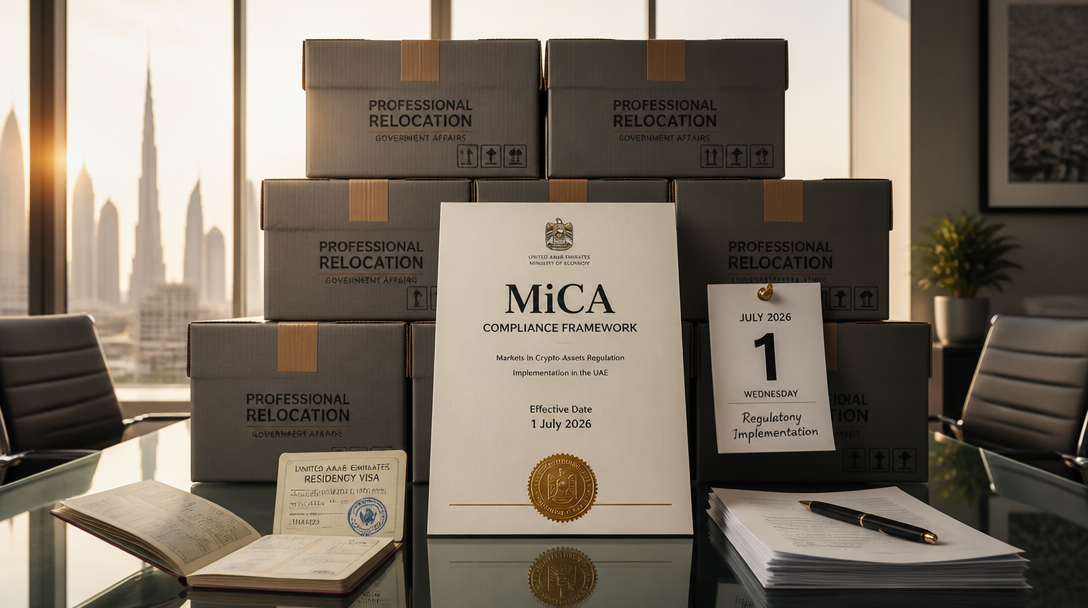
Crypto entrepreneurs rush to UAE for faster licensing ahead of EU’s July 1 compliance cutoff
European cryptocurrency founders are relocating to the UAE in accelerating numbers to escape the European Union’s Markets in Crypto-Assets regulation, which takes effect July 1, 2026. The deadline forces firms without MiCA authorization to cease serving EU clients across the 500 million-person European Economic Area.
NeosLegal, a Dubai-based law firm, is fielding 120 inquiries per week from companies and founders seeking to establish operations in the UAE, with 50% originating from Europe. “The inquiries from European founders skyrocketed,” said Irina Heaver, a lawyer at NeosLegal. “They’re looking to move themselves and their wealth and their ideas and their intellectual potential to a country that welcomes them.”
The migration reflects a stark difference in regulatory approach. The UAE’s Virtual Assets Regulatory Authority (VARA) was created specifically to oversee the crypto industry, enabling companies to establish operations in days rather than months. European regulators, by contrast, typically supervise both banks and traditional financial institutions alongside crypto firms. Heaver, who spent 13 years writing laws for oil and gas companies before moving into crypto, offered a blunt assessment of the regulatory dynamic: “When you get the foxes to write the laws about protecting chickens, you get MiCA.”
A UAE license grants access to markets across Asia, North Africa, and the global south, encompassing 4 billion potential customers. That reach extends far beyond Europe’s constrained market, making relocation economically rational for founders who view the EU as increasingly hostile to innovation.
Erald Ghoos, CEO of OKX Europe, stated that 80% of crypto companies would not survive MiCA compliance. Last week, Binance withdrew its MiCA application in Greece and notified EU users it would suspend some services. The exchange said in a statement to CoinDesk: “Our ambitions in Europe remain the same, and we are confident we will secure a MiCA licence in the coming months.” The following day, OKX and Coinbase announced deposit and transfer bonuses of 8% to new users, a move that may signal preparation for expanded operations outside the EU framework.
Heaver emphasized that relocating founders are not inexperienced operators. “They’re not just some random guys. They’re former founders or current founders, somebody with multiple exits, somebody with years of experience in crypto,” she said.
The migration carries strategic implications for Europe’s tech competitiveness. “I can see a brain drain. I can see a tax drain and also the loss of jobs,” Heaver said. “If a founder with a couple of exits established in the UAE, it’s going to bring new jobs to the UAE. It’s going to create opportunities in the UAE. I feel Europe missed that opportunity.”
The pickup in UAE relocation inquiries began 18 months ago, before MiCA’s initial rules took effect. Stablecoin regulations under the framework began applying roughly one year before the July 1 deadline, giving early warning of the compliance burden ahead. The final deadline now forces a decisive choice for firms operating across EU borders: obtain authorization or exit the bloc entirely.